Another Difficult and Anxious Night for Kyiv, but We Did Withstand The Attack. What Comes Next?
Today, we can confidently say that this time, too, Russia’s massive missile and UAV attack did not surprise or frighten anyone in Ukraine. It also failed to impress the West, and therefore our partners will continue to support Ukraine in its just war against Russia.
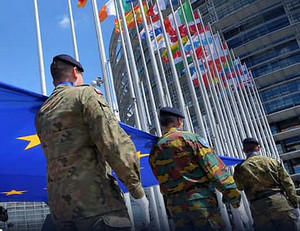
The EU has also stopped relying solely on security guarantees from the USA and is now seriously considering the creation of its own international security system. Europe must think on a larger scale and shape a new security architecture which could include Ukraine, the United Kingdom, Norway, and other partners.
This statement was recently made by France’s Minister Delegate for European Affairs, Benjamin Haddad, at the GLOBSEC security forum, which took place May 21–26, 2026, in Prague. Former Prime Minister of France Michel Barnier also believes that Ukraine should be included in the European intergovernmental security framework even before its accession to the EU. Given the statements by these prominent French politicians, as well as the positions of Germany and the UK, Ukraine’s prospects in this regard are clear.
As for Russia, its future looks far less promising. Exhausted by the war with Ukraine, it is becoming increasingly dependent on China, which will by no means support its imperial ambitions but will merely use Russia as a counterweight to the West – and only for a limited time. When that time comes, China will reclaim its historical territories from Russia – and perhaps not just those – and will subsequently attempt to turn the Russian Federation into its own raw materials appendage.
Russia has also begun to lose ground in the Caucasus. Armenia has already taken the first step toward distancing itself from Russia. Georgia should be expected to do the same in the near future. Separately, attention should be paid to the North Caucasus. As long as the Russians could financially support Kadyrov, the situation in the region was more or less stable for them. Now that 40% of the economy is working for the war, a significant financial crisis is expected in Russia, which in turn will force the Russians to stop subsidizing the North Caucasus from the federal budget. Obviously, this will have extremely negative political consequences for Russia, but in the context of a deep financial and economic crisis, it will be forced to take such a step. It is worth mentioning here the demographic and religious factors, which are of particular importance in that region. Therefore, in the near future, public displays of mass dissatisfaction with Putin’s policies and an intensification of separatist movements – though it would be more accurate to use the term “national liberation movements” – should be expected in the North Caucasus.
Most likely, given historical experience and the distinctive national character of the peoples of the North Caucasus, Chechnya, Ingushetia, and Dagestan will be the first to seek to secede from the Russian Federation. It is difficult to say exactly when this will happen, but due to the Russians’ lack of clear success in the war with Ukraine, the process of the Russian Federation’s disintegration has already begun, and its signs are becoming increasingly noticeable. In this context, new threats and challenges will begin to emerge in the world, for which we must be prepared if we do not want to be left on our own to face them and perish under the ruins of the dying Russian empire.
Oleh Bereziuk,
Institute for Global Politics